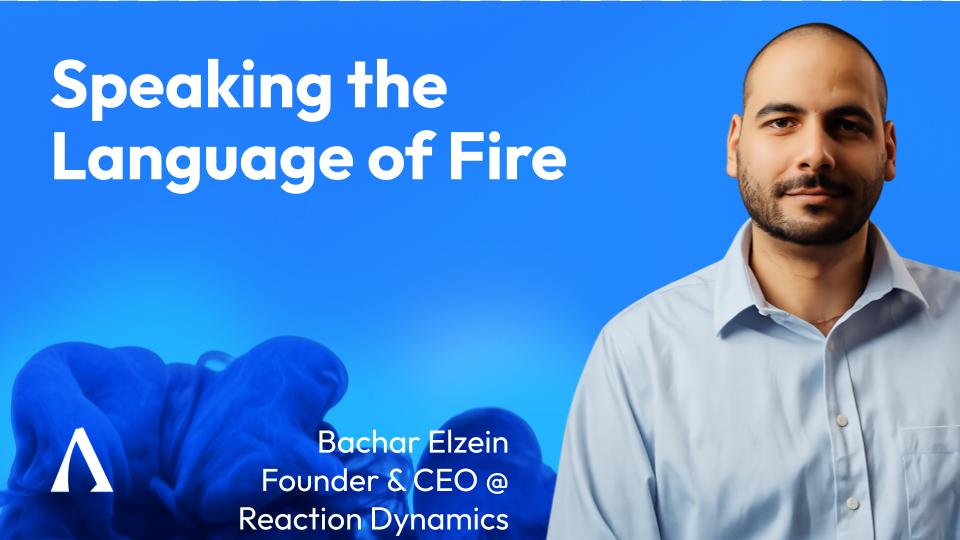
The Canadian Founder Building a Rocket to Orbit, Bachar Elzein, CEO & Founder @ Reaction Dynamics
Apr 22, 2026
Bachar Elzein was 13 years old, living in Lebanon, when a Discovery Channel documentary on the Apollo program changed the course of his life. The same week, his uncle brought home a rocket propulsion textbook from a sidewalk book vendor. He took both as a sign.
What followed was two decades of singular focus: engineering school at Polytechnique Montréal, winning an international rocketry competition against Stanford and MIT as the first non-US team ever, a research partnership with his professor, and eventually founding Reaction Dynamics in 2017 — with nothing but the technology, the conviction, and very little idea what a pitch deck was.
Nine years later, RDX is targeting its first suborbital launch in October 2025 and orbital launch in Q4 2028. They've secured backing from Tim Draper and a landmark federal contract through Canada's IDEaS program. And they're building something no other launch company in the world can offer: a fully containerized, mobile rocket system that can launch from virtually any location — no fixed infrastructure required.
In this conversation, Bachar walks us through the core technical insight behind RDX's hybrid propulsion system, why simplicity beats reusability at this stage, and what it means strategically to be able to launch a satellite from an undisclosed location on short notice.
We also go deep on the founder journey: the nights he wasn't sure the company would make payroll, why he never once doubted the mission, and what nine years of advocating for Canadian space sovereignty finally feels like now that the geopolitical moment has caught up to the vision.
In this episode:
The hybrid propulsion breakthrough — and why no one had solved it before
Why RDX designs for cost, not peak performance
Containerized launch: what it is and why defense customers care deeply
Canada as the only G7 country without sovereign orbital launch capability
Surviving a pandemic, an economic crisis, and skipped payroll
What Tim Draper told him about conviction and boldness
Why customer validation matters more than a great pitch deck
The road to orbit: suborbital in 2025, orbital in 2028
Transcript
Nectar: [00:00:00] Bashar super happy to have you on the podcast today. I think there's so much to grow to cover, but I also wanna be respectful for your time. I find it's like we were talking about before recording where it's okay, like there's not that many startups that are literally at the center of geopolitics space exploration.
Nectar: Before we get into your company and why you started, it's like maybe you just like, how'd you get interested? I imagine as a young kid, right? Like you're influenced
basic.
Bachar: It's always something I wanted to do. I think it's a blessing and a curse since I was. 13, I believe.
Bachar: I knew that I wanted to build rockets. It's a curse because it's the only thing I wanted to do. I knew that my life is gonna be revolving around rockets. And as funny as it is, it was watching a documentary on Discovery Channel that I figured out that, okay, this is really what I want to do.
Nectar: What was the name of the documentary you remember?
Bachar: It was a it was, a memorial on the Apollo program, I believe, I think it was the 40th year or 50th, three year. Can't remember. It was like around 2003. 2002. 2003. 2003 to be precise. So there were [00:01:00] like there featuring some of the early missions of the Apollo program and such.
Bachar: And the 40th. Yeah, it was the 40th and and, rockets are fairly compelling because they're very easy to understand. The science behind rocket is very simple to understand, but it's really the engineering that is excruciating. So for a child, you see this, you watch this, you understand this.
Bachar: It like having the sense that you understood something yet so complex was I think very very compelling. And it's a funny story because, so I was born here, but I grew up in Lebanon and there in that city where I was in, we used to have a salesman like a book salesman, a librarian that used to sell books on the sidewalk.
Bachar: Every week he would have new books, and my uncle was coming back home and he picked up a book on rocket propulsion of all topics. And he he he brought it just like around the same week or so that's you know what? I wanna build rockets. And he came up with that book. So for me it was like, it's a sign, it's a sign from God, this is the thing.
Bachar: And, [00:02:00] it was I still have it, in fact, as funny as it is, still have it. And it's it's a book used by engineering students, French engineering students to pass their exams. And it summarizes all concepts of propulsion, rocket propulsion but also it goes deeper into gas turbines and all these things.
Bachar: And I ate that book. I started, it's I dug into it. Since then, I think it was really, I understood when I came back to Quebec with my family at 16 my goal was really to get into engineering school to be an aerospace engineer, to be a rocket engineer.
Bachar: And that's how I got into Polytechnique later joined a student team called Oros. My colleagues and I were part of the first, cohort of rookie that that that the founders in fact trained and our goal that are, in fact, the group still exists. They're still doing really well.
Bachar: It is to build sounding rockets, experimental rockets to be part in the competition. So we would design build and launch these rockets every year. And we ended up winning that competition on the first year. We won that [00:03:00] competition on the second year as well.
Nectar: Were you competing against
Bachar: well, schools like.
Bachar: Stanford, MIT, Yale. Wow. Et cetera. And you also won on the third year I was a team's technical lead. So we were the first non US team to ever win that competition, which was really cool. So it was a bit like a, a vindication of a calling if you want. And that's what got me to research after with the, my professor with Robert in around 2015.
Bachar: And, started RDX about three years later. Two years later.
Nectar: Yeah. 2017 ish.
Bachar: Yes. Correct.
Nectar: Nine years. It's like a nine
accomplishment.
Bachar: Yeah.
Nectar: Maybe to get into the controversial stuff right away. So Star Wars or Star Trek.
Bachar: I'll be even more controversial. I haven't watched neither nor
Nectar: Oh, wow. Okay.
Bachar: Yeah.
Nectar: Okay. I'll
Bachar: say more Star Wars because I, maybe I've watched like two movies, star Wars, but yeah.
Bachar: Famously I haven't watched any movies or very few movies. The city I grew up in Lebanon, we had no cinema there, all the movies I watch were on TV or stuff like that.
Nectar: But it, I wanna go back to your point about the book and like what drove you and obviously I was teasing it out, so it's it's not, is it the space exploration part that drives you?
Nectar: Or it's [00:04:00] really Okay, this technical challenge of okay, there's this thing that has one of the most complicated feats that you know. Humans can do is this whole notion of sending stuff into space. What do you think is the intellectual curiosity that the
Bachar: chip on? It's a very good question, and I've asked myself that question.
Bachar: In fact, I haven't asked that question. And there's no
Bachar: I think the challenge itself, is more of a driving factor than space exploration itself, as in building those rockets making it. It's a beautiful technology, like beautiful machines and being able to master or speak the language of fire. I think there's something around that.
Bachar: And given it is, no. Two rocket engines are the same. No two launch vehicles are the same. And every one of these systems, whenever you're launching a satellite into orbit, you know that the team building that rocket had to go through a different set of challenges. Of course, a lot of challenges are common, but the solutions people come up with I think this is the exciting part and.[00:05:00]
Bachar: Space being the final frontier? I think it's it's, it gives, it it gives rockets and launch vehicles the, their letters of Nabil, if you want in a certain way. So it makes the application even more compelling. But I was initially driven to the excitement and the challenge and the.
Bachar: The understanding the understanding of the simple science behind propulsion, but the complex engineering of it is like how do you ensure that you are properly converting your propellants and. Through that combustion into kinetic energy and velocity through the nozzle without ensuring that your rocket engine is melting down because the temperature of combustion of these propellants far exceeds the melting points of the metals you're using to build those engines.
Bachar: So you have to cool it, but you also have to inject those propellants at high. So how do you do that? And you have to make sure that you have the right amount of fuel, the right amount of oxidizer. So it adds up and it adds up. And what makes a rocket so hard, in fact, so complex, is everything is [00:06:00] so coupled.
Bachar: If you have more pressure somewhere or less pressure somewhere, it'll have a big influence on everything upstream. If you end up adding a few kilos on your tank while you're altering your mass ratios and you're altering your delta V, you're altering your success at the whole mission.
Bachar: So you have no margins or very few margins and everything is soak up. So it is the ultimate couple dynamical system. And you're dealing with such a wide array of sciences and engineering disciplines. You're dealing with thermal, you're dealing with mechanical engineering, you're dealing with materials, you're dealing with propulsion.
Bachar: And if you dig into propulsion while you also have the propulsion specific materials you have the combustion process, which tend to be. Super complex to understand. And all of these things have an influence over each other. If you're not converting properly you are your combustion into the right type of energy, you can easily, I, if you convert a fraction of that energy into mechanical energy vibration [00:07:00] you can.
Bachar: End up in a situation where you have combustion bilities your engine is not stable anymore. Like so many things that, you know, trying to. And that's, I think, what makes it so interesting and so exciting.
Nectar: Yeah. You mentioned that, the simplicity of it yet, the complexity of it.
Nectar: It's I think just anyone can understand you've seen a launch.
Bachar: Oh, a hundred
percent.
Nectar: It's okay. It's very simple. It's like going, but then the complexity behind it's crazy. And so you wanna go back to, okay, like it decided to drop out and and then launch this. I think the classic startup story is easy to understand for a software company where it's like the, the proverbial.
Nectar: People in the garage, tinkering on a laptop, but it's okay what does that look like if you're a rocket company? Yeah. So what is that first year or two? Do you need to get money? Is it
Bachar: Oh, a hundred percent.
Nectar: Yeah.
Bachar: It's
Bachar: at the beginning when I started, when we started this company, we had that predominant idea that we've built rocket engines in the past. The rest is gonna be easy. The hardest part is building the rocket. But everything else, of course, is gonna be easy, but it's it turns out.
Bachar: It's not the case at all. Running cash flow [00:08:00] when you've never done it before. Like this company was my first real job and my first real company. And my goal is I wanted to be the last one. I'm not building this to, to to like when you've spent so long over something it's because you wanted to succeed in the most in the most ferocious way possible.
Bachar: How do you run a cash flow? How do you manage, how do you pay your taxes? How do you I'm talking about the very silly stuff at the beginning. It's really realizing that building a company and running a company it's own thing, it's own. So it was a little bit of hubris and a little bit of arrogance.
Bachar: It's yeah we're rocket engineers. We've built rockets, engines in the past. Everything else will be easy. How hard can it be? It's ah. And then you realize that, oh, this is actually it's complex because we talked about the complexity of building a launch system or a rocket engine, compassion, stability and ensuring you have the right mass flows and right pressure and turmoil and cooling.
Bachar: It's the same thing with the company because you need funding. And how do you fundraise and then you have to [00:09:00] ensure that you are doing the right things and you have the right permits and the right licenses because then you have to get your propellants and you have to build a test site and you have to these are all things where I cannot build a test site in Montreal because of noise, the regulations.
Bachar: So you have to go somewhere else. And how do you make sure that you're so it's all these things that you don't necessarily learn and don't necessarily expect. And when you're doing a deep tech company, especially like a rocket company, you really have to be by the book on a lot of things, and there's no margin for error and you don't want to have you don't want to be caught doing something you shouldn't be doing.
Bachar: And you shouldn't be doing that. In fact, it's because you're dealing with like very high energy systems. So anything you do in the wrong way can really hurt. You don't want to have any people injured. But beyond that it's really, I would say, the realization of all the different things you have to do to make a company function, fundraising having a shareholder's agreement and having contracts and, sometimes you think that you can play lawyer and play accountant and play all these [00:10:00] things, but then you realize that maybe we should bring some help and do things here and there.
Bachar: And I think the first two, three years that was really just trying to. Master the magnitude of what it is to run a company and what it is to overcome these challenges. And overall just trying to ensure that we have the ability to capture the resources we need to capture as a company, to hire, to scale, to demonstrate the technology we're looking to demonstrate.
Bachar: And also to ensure that we.
Bachar: Don't run out of time before we've learned the things you have to learn to keep moving forward because it's, it's very easy to run out of time, run out of cash.
Nectar: Yeah.
Bachar: Yeah.
Nectar: I was gonna say, it's like I, I have very little understanding about rocket startups at rocket companies.
Nectar: I understand. It's there's, it's definitely like the hardest form of startup, right? Having followed the story of SpaceX that's very well known and it's it's not easy at [00:11:00] all. I wanna get into this insight, right? You spoke about propellant, right? As the main way, that we've been doing this for, since we started this whole semi stuff into orbit, you've come up with an insight of hybrid, right?
Nectar: Talk, talk to us about this.
Bachar: Hybrids are not. I did not invent hybrids. They've been around since the thirties or the, with a fantastic use case for low cost production and simplicity. Hybrids were not used for orbital launch in the past because they did not meet the performance requirements due to their unsteady combustion yield.
Bachar: So you could drown a hybrid rocket engine for at high efficiency, but only for a few seconds. But then. As you go through your burn time, while your combustion efficiency goes down because you have a shift in your mixture ratio due to the nature of how a hybrid rocket engine is built and a hybrid, the fuel is stacked in your combustion chamber.
Bachar: And as you fuel burns you alter your. Oxide reflux and that in [00:12:00] itself will have an impact on the regression rate of the fuel. So the amount of oxygen or oxidizer you're burning and the amount of fuel available in your combustion chamber to burn changes throughout the time and that change.
Bachar: Will force you in a position where you're not burning efficiently, or you're not burning at peak efficiency. And a rocket, a launch vehicle is 90%, 95%. It's propellants, 90% is fuel and the oxidizer you're carrying. So if you're not burning even a small fraction of your fuel and oxidizer at peak efficiency while if you're adding rocks to your launch code, so you're losing your ability to insert payloads into orbit.
Bachar: And this is really important. By understanding the driving mechanisms behind the regression rate and understanding how these mechanisms can be altered have been able to basically make that discovery and. Put in place a new architecture of rocket engines featuring hybrids that allow these engines to run at peak [00:13:00] efficiency for long durations.
Nectar: Yeah. What's the material itself, right? There's one as a fuel, but then what is the other?
Bachar: The other one is the ox desert and it's hydrogen peroxide. So 90% hydrogen peroxide H2O two. That undergoes a catalytic reaction when it's injected through an catalyst. But how do you ensure that?
Bachar: The fuel, the right amount of fuel is burning in the combustion chamber when it is subject to the oxidizer that is available. That's, I think that was a challenge. And then, and that is done by multitude of, it's not like a single thing, but it's a single thing to which you added another one and another one because each of these.
Bachar: Innovations will give you 5%, 7% extra performance. The other one will give you 3%. But if you combine all these things together you are in a position where you can run your hybrids at longer durations for at peak efficiency, in fact and make it possible. Does it have the same efficiency as a liquid?
Bachar: It's a little bit short of what you would get with liquid, but it's way cheaper. It's way [00:14:00] cheaper and way more affordable. And that gives us it's a change of paradigm. In fact, as in you're not necessarily designing for peak performance, but you're designing for peak. Cost you, you're basically your cost function is really your cost.
Bachar: And that's, I think where you build with the tools you have.
Nectar: Yeah. So my understanding is that this enables you to, obviously you carry smaller payloads.
Bachar: Correct.
Nectar: But at a much more affordable rate. So like in essence as the whole space economy is being developed. We're gonna talk about that in more detail.
Nectar: This allows you to launch more satellites extremely cheaply.
Bachar: You're correct. So basically that. Puts us in a position where we're capable of launching 200, 300 class payloads at a fraction of what it would cost to launch with competitors using liquid field rocket engines. And I think this is really what we focus on, as in by removing complexity from our propulsion, we're able to reduce the cost.
Bachar: And that is really what's [00:15:00] important because the alternative, you add complexity. Reusability is a amazing solution and it's something that we have looked at and this is something that we will look at as we go further. But reusability introduces a lot of complexity. To reuse a rocket, that means you have to have.
Bachar: Very high efficiency engines. You need to have a very high trust rate ratio. You need to have a very decent high speed. You need to have super light structures because when you're landing back your rocket you need to carry some fuel and oxidizer some overhead. In fact, some some some.
Bachar: I don't how the word English but some additional fuel and oxid so that you can properly land your rocket. So that is propellants. Those propellants are propellants not used to propel your second stage and give it velocity, but you still have to have very light structures. You still have to have very efficient guidance, very precise control, because you need to land that rocket even if you're not landing, even if it's parachutes.
Bachar: All these things are [00:16:00] very complex, by and the goal of reusing is to reduce your cost for each and every launch because you're basically picking up the core or the bulk of your infrastructure of your assets and reusing those, but to push it further, the reason why, like the biggest.
Bachar: Upside of using has been the increase of launch cadence. You're able to launch more often, more frequently because you have less production to go through. That adds complexity. All that adds complexity. So by concentrating on the first step by concentrating as a first step on hybrids, we're able to remove some of that complexity and.
Bachar: Build systems that are simpler, that can still be very competitive and gives us that edge on the cost.
Nectar: And my understanding is also having visited your beautiful facilities, that it's also way safer, right? Because it's like you don't have to have this like literally rocket fuel, correct. That [00:17:00] we've seen rocket explosions.
Bachar: You you saw the fuel, you can touch it, you can literally burn it.
Nectar: So you can transport this, have it stored on site at different launch locations, right?
Bachar: And these things, in fact, not all hybrids rely on Sobel propellants. Some hybrids will still rely on cryogenics and not all liquid field rocket engines rely on cryogenics.
Bachar: Some liquids will rely on sobel. So I think it's a very deliberate designed choice that you make initially. Which is, and I think it's it's, it is the most consequential design decision you'll make when you design a rocket is. What are the propellants you're burning?
Bachar: What's the fuel you're choosing? What's the ox desert? And once you decide to, once you make your pick everything else is downstream. The technologies you'll be using for your propulsion, you have fewer options. The kind of complexity you'll have to deal with, your logistics, your ground operations, all that is really bound by your shows propellants.
Bachar: In our case, the Choice App Propellants also gives us advantages because both the fuel and the Oxid Desert are [00:18:00] durable which means they're stable at room temperature. We don't need the complex cryogenic infrastructure. It can be transported safely, it can be stockpiled. It can be, gets healed, it can be hidden.
Bachar: So that gives really a lot of advantages when you're doing satellite replenishment, satellite reconstitution all type of missions. So that gives us flexibility that you don't typically find with more traditional systems.
Nectar: Yeah. Yeah. And maybe walk us through Bouchard, like where's the state of your technology today?
Nectar: My understanding is you guys are gonna do your first suborbital this year,
Bachar: correct? Correct. We're very,
Nectar: and then two years targeting for,
Bachar: orbital. So we're aiming to have a subro launch in October this year. We are. Demonstrating the performance of our hybrid rocket engine in a near space environment.
Bachar: High altitude. We're also demonstrating its ignition mid-flight, which is very important when you're trying to reach orbit. And we're also demonstrating ignition post separation. So we'll separate the two stages. [00:19:00] Hybrid will ignite, it'll keep flying. And this is fairly key because these technical risks are.
Bachar: In fact, this demonstration is will help us mitigate the technical risks we'll have to undergo when launching an orbital rocket. Ignition post-separation is a common reason why rockets fail not having enough performance. It's less common, but there's also a reason why rockets, orbital rockets fail.
Bachar: One of the key. Demonstrations were, we're able to to to accomplish through that site is our ability to transport. The whole rocket containerized, we manufacture containerized rocket systems with orbital launch capabilities. So being able to have everything shoved in containers fueled shipped to the launch site, and then being able to pick up everything and launch shortly.
Bachar: This is also something we want to show so that rocket launches from Australia something that beyond on Canadian soul which adds more complexity, but this is also something we wanted to validate. [00:20:00]
Nectar: The ability to, like you said, put stuff in containers, ship it across, like how does that affect your business model?
Nectar: Like in a sense, does that, what kind of markets does that open for you?
Bachar: It gives us, it gives our customers more optionality, man. It gives our customers more flexibility, which is something they're not necessarily accustomed to. So when you are opening up that much. Flexibility to customers? There are a lot of things they can do with it.
Bachar: That can be fairly interesting for them. You're giving 'em tools they did not know existed. See it that way. What kind of market? '
Nectar: cause no other company does this, right? My understanding is
Bachar: no other company can launch from, the back of a truck in a forest, or very, in fact not as far as we know.
Bachar: The ability to have trouble propellants, the ability to have a simple system, the ability to not rely on fix infrastructure for launch gives us that optionality that we can offer to our customers. It is very relevant for defense applications. Very relevant.
Nectar: Yeah, I was gonna say, it's like I find like it's not talk about war, it's not a good time for war, but
Bachar: Yeah, exactly.
Nectar: [00:21:00] Exactly.
Bachar: It
Nectar: seems to be a very good thing if a country wants to launch a spice satellite,
Bachar: pretty much. Or if you want to replenish or reconstitute or replace a spice satellite that was jammed or destroyed. Because we all know where the Space force are. They're known. So being able to launch from an unpredictable location, that gives us, as a country more resilience and more optionality, in fact and allow you to be more robust overall.
Nectar: Yeah and is that the think it's a good time for our conversation. You guys recently won, the award. The award, and you've been banging the drum on.
Nectar: The need for, we're the only G seven country, without which much sovereign launch capability, right? No, the term sovereignty's become very popular very a buzzword today, but you guys are like the OGs in that space. So first congrats on the award. Thank you. Walk us through what that means for reaction dynamics,
Bachar: As you mentioned, yeah.
Bachar: We have been advocating the importance of sovereign launch for the past 10 years, and we're very pleased to, to be aligned with the priorities of the government when it comes to sovereignty sovereign launch [00:22:00] and the importance to, own that capability as a country. Not being able to launch our own satellites means we have to rely on foreign assets.
Bachar: We have to rely on our partnerships, which have served us really so far. But in a world that is so quickly changing it is important to have that sovereign capability. It's really important. So we're very pleased because it sends a very strong signal to, our partners, it sends a very strong signal to potential investors you're talking to that this is important, that the country needs this.
Bachar: So seeing minister Megan thi make the announcement was really, very encouraging. It's very important. And we knew that the tide is turning and that's something where we don't have to justify and explain anymore the relevance of launch, because that has been the question that we had to answer.
Bachar: I would say in the past 10 years. The most often is like, why do we need the Rocket Company Canada? Why do we need to have you? When we have SpaceX and we have Rocket [00:23:00] Lab. Great companies. Amazing companies and SpaceX have done an amazing job reducing the cost of launch. And we look up to them on a lot of things.
Bachar: But we do believe we'll have a solution that is so distinctive that can, it'll allow us to compete in that market despite having giants like SpaceX, despite having great companies like Rocket Lab. So by offering such a capability, we believe will have our place in the market and. Knowing that now we have the back the full support, the full backing of the of d and d that is one less thing we have to worry about.
Nectar: Yeah, it took a little bit of a shock to the system. Like an external shock to, to wake the country up a little bit. With the new administration. But obviously it's a very good thing that we're pushing it into, we'll take it into these areas. Absolutely. Yeah. Like I said, good to be lucky to be good as they say.
Bachar: Exactly.
Bachar: Yeah, we had to survive a pandemic and we had to survive a economic crisis. And you have being around for nine years you have to go through a lot of stuff to, to stay alive. Yes, having that change is something that we we welcome.
Nectar: But maybe on that front, right?
Nectar: Like you're the founder [00:24:00] CEO and CTO of the company, man. Like how did you do this in the sense of, I imagine there's been more than one night where you're up at the ceiling Oh, in the middle of the night, like, how's this thing gonna stay alive? What, what drove you to stay to persevere?
Bachar: I'm very fortunate to have the team that I have that's for sure. Knowing that I'm not alone doing this, knowing that I have extremely capable co-founder Max is incredible. Cannot talk highly enough of him, but also have a team, have a very strong backing that gives you further all the reasons to keep pushing and our the deeper, that's my calling. That's that's my profession. Like what else am I gonna do? So it's really, when you believe it is worthy enough, it's easier to keep pushing. And that wouldn't be possible without the team I have without the investors I have, without the backing of all the people that supported us at the very beginning when sovereign launch was not a cool thing.
Bachar: Did we have difficult times? Of course, we had instances where [00:25:00] we were not sure the company, would make payroll more than once. We had to skip payroll, unfortunately. But never ever did I doubt that this would end up being something one day. Of course, I don't wanna talk from a position of we've accomplished something we haven't, as long as we haven't reached orbit.
Bachar: For me it's, we're still not there. It's success for me is reaching orbit before reaching orbit. That's irrelevant.
Nectar: Yeah. It's the first. Big step.
Bachar: The first start. First start, yeah. Launching a rocket to space it's impressive having a demonstration. It's very impressive. But reaching orbit is really, we build this company to reach orbit and launch satellites.
Bachar: Not to do anything below that. Not to do anything other than that. And this is really the priority. So I, I don't wanna talk from a position where, hey, we've accomplished something. We are yet to launch orbit. We're yet to do that. We needed all those years to, to advocate and to push and a little bit of a change of geopolitical stage to really further vindicate and validate the relevance [00:26:00] of what we have been proning for all these years and what we have been advocat advocating for.
Bachar: So if that's what's needed so be it. But yeah it has not been easy, I would say in the past years. But now things are different.
Nectar: Yeah. If you, I followed the story SpaceX a little bit, right? The book and there's been a thing, a few books on on, on, on them. And nearly, this is clearly two phases of the company, right?
Nectar: It's like the pre orbit and then, I think they had four failed launches.
Bachar: They had, yes. Correct.
Nectar: So
Bachar: they had three failed launches. The fourth one succeeded.
Nectar: That's it. Yeah. So three, and then the fourth would be making, but it was like literally the last shot, right? There was no more money in the bank.
Nectar: Mr. Musk had nothing left. And that was the one that made it right in 2008. And then since then, it's been, obviously they've had TE technical leaps. How, maybe the question of I don't wanna talk about tam, but it's related to it. It's like we mentioned about. Countries are now waking up the fact that hey, we need to have our own sovereign capability.
Nectar: Correct. So Correct. You'll be the first Canadian company to do this in China, like in, in India. That's the goal. Yeah. And then how, the goal is to export this capability to other countries, I imagine?
Bachar: Definitely [00:27:00] yes. Being able. So how do we see the future in the next five years? We see that future as a future where we have rich orbit, we're able to provide a country with that sovereign capability.
Bachar: But we also see a future where we are an exporter of launch to our allies, to countries that don't necessarily have that launch capability. Having a containerized launch means that I. Ship stuff in containers, land in Poland land in laia, land in any of these allied countries, and launch satellites from there as needed or launch satellites from somewhere else when needed.
Bachar: So having that capability means as a country we can. Leverage that, that capability to further our relationships with our allies to give something so that we can get something in return. And it's actually very exciting because space is a more and more contested domain. It's gonna be more and more strategic.
Bachar: It's gonna be more and more demanded, I would say. So having access to orbit is something that's gonna be very important as we move forward. And more and more the goal is not only so we, we want [00:28:00] to serve the canid market. There's also a need to build a bigger launch vehicle, which is something that we have been exploring actively for the past few years, I would say.
Bachar: But you also wanna be focused on one thing. We don't wanna be running before we can walk and we don't wanna be walking before we can crawl.
Bachar: So we're now in the crawling phase, and then we'll start walking. Then we can start running. So we are laser focused on delivering orbital launch capabilities, but yes.
Bachar: As soon as this is the goal, as soon as this is accomplished we want to be in a position where we can, help and support our allies help and support companies from all over the world to reach orbit in the most efficient way. The and while being very responsive. So cost is important.
Bachar: You have to be affordable. But when you're able to launch, would very be short lead times. That's a value in itself that, that creates value to customers that is beyond the pricing.
Nectar: Yeah, I was gonna say, 'cause the KPI everyone talks about is the cost per kilogram per kilo.
Nectar: Correct. That famously SpaceX has been pioneered to, to drop by 10,000 x and you, so you bring another element to [00:29:00] that where it's like time to launch, right? Correct. So it's we're talking about tighter zona, where it's like they have to take a number and wait for SpaceX to basically have.
Nectar: Availability to correct, to, to put them on you. You're able to basically do that very quickly
Bachar: And that's how we're able to leverage the simplicity of hybrids and the simplicity of the overall architecture that we have been focusing on. Responsiveness is throughout the whole value chain.
Bachar: It is in the manufacturing, it is in the ideation. What do you choose? To focus on what you choose. What are the design decisions that you'll make to ensure that you can be responsive? And that is through choosing the right propellants so that refueling operations can be reduced on the launchpad.
Bachar: This is by choosing the right technologies so that your manufacturing process can be reduced. This is by choosing the right. I would say propulsion so that your flight termination system can be simplified. So that allows you to get your regulation papers and all your launch [00:30:00] licensing in a shorter time.
Bachar: And also by ensuring that you integrate with your customers and that you talk to them so that okay, so what do you need to integrate your satellite, major satellite on my rocket? So we don't need months to do it. So responsiveness is throughout the whole value chain. So by making these intentional choices from the get go.
Bachar: We haven't able to shorten the lead time. And yes, the price per kilo is important. We're not gonna, we're not gonna sugarcoat that. It's really key. But a satellite company, we've seen numbers. On average, their burn rate is anywhere between. Half a million to a million dollar per month. So every month of delay this is extra cost every month where your satellite is not being put in orbit.
Bachar: That's a month where you're not generating revenue, and that's a month where you have to burn further. So by able, by being able to reduce the lead time, and by being responsive well, we're able, we're helping companies generate revenue earlier, but as importantly. This capability is strategic.
Bachar: So when you're talking to d and d or when you're talking to [00:31:00] defense customers or will use they want to have that satellite in orbit as soon as possible. And in some cases this is priceless. Being able to replace a strategic asset that was jammed or destroyed. No amount of money can replace that.
Bachar: So by having that capability we're able to open up yeah, more options.
Nectar: Yeah, no, you don't wanna reveal too much about your roadmap. I just mentioned crawl, crawl, crawl, crawling first. But beyond in terms of payload, is it just really satellite satellites? Is there anything else that you can envision,
Bachar: Where Yeah, only satellites we're also.
Bachar: Exploring other options, I would say commercial and for dual use applications. But, basically everything south of the payload we can do. We have worked on in space propulsion guided propulsion for satellites. We have been selected by the Canadian Space Agency to provide such a system for satellite that should fly in about a year and a half.
Bachar: We're also working on the launch that that we're known for. And we also have a few other applications that will be announced or shared or disclosed a little bit later, I would say. But yes, everything that is south of the [00:32:00] payload, this is something we do.
Nectar: I imagine you've heard every single objection from investors, right?
Nectar: Oh, it's like it's. Going back to like building a company in hard mode but you raised a bit of money from Tim Tripper, right? Like one of, if one of the top, if not the top, venture capitalists, what are the lessons you learned about convincing people to buy on this like very hazardous journey that're on
Bachar: specifically with Tim?
Bachar: I would say be bold. That's that's, and that's something that he preaches a lot. Tim is one of the best investors you can ever have. Great. Very generous, great guy. But I would also say it gave us a lot of credibility and a lot of it's, we've bragged a lot about having Tim since we had him as an investor, and I think this is really cool because it's something to believe in what you do and keep pushing for all these years.
Bachar: It's something else to have someone as credible as Tim validating the relevance of what you're doing because space and launch it's a very technical field, like there's no way around it. So the overlap of investors that [00:33:00] can. Write a check and properly understand what you're doing. It's very small.
Bachar: And most of these investors, some of them have already invested with other companies. So you try to, they're, you know it as much as I do. Some investors will really focus on the vertical and invest in two, three competing companies. Some investors will invest in different verticals and try to support their horses if you want.
Bachar: And, parallel and lon, it's not very common to have investors investing in more than the rocket company, given that rockets tend to be expensive. The CapEx required, like the amount of money you need to reach orbit is agreed to be about a hundred million dollars. Anything below that, like no company has reached orbit with less, and this is pretty much what we need to reach orbit.
Bachar: More than that's okay maybe it's a different system, maybe it's a bigger rocket, maybe. So being able to leverage someone leverage the credibility of someone like Tim has helped us a lot. And we're very pleased you have him on board.
Nectar: Yeah. Yeah. That's exciting. It's exciting.
Nectar: What are the lessons you learned about fundraising? Like you mentioned being bold, but what else?
Bachar: I can maybe spend an hour about [00:34:00] that. It's important you have conviction before you ask people to have conviction around. Your product, you have to have conviction around what you do. And that implies having, and I'm not saying conviction to the point of delusion.
Bachar: You have to be a little bit, but. Conviction from a standpoint of knowledge, I think is the best. As in we understand the launch market extremely well, and we have been able to predict a few very interesting trends that have been vindicated each and every time over the past five or six years.
Bachar: So understanding the launch markets the way we do. And understanding the technology that we have built the way we do gives us that faith into we're building something worthy. We're building something that's relevant, and more importantly, we're building something that is in demand, something that is needed.
Bachar: We understand that demand and. I don't need to dig very deep. The customers we've been talking to it's been fairly easy to [00:35:00] us. Not fairly easy, but we have been punching way above our weight when it comes to Lois and traction, even though, we have a very small team, super capable team when it comes to business development.
Bachar: Extremely capable. But it's it's when your customers. Validate and like what you're doing, that's what counts the most.
Nectar: Yeah.
Bachar: Investors will follow investors. Conviction is very important, but at the end of the day, you're building a product or service to serve customers. You have to create value to someone who will be buying something from you.
Bachar: And I think that's the loop where founders very often will go chase the investors and build their whole case around. Having a great pitch deck. Having, I did not know what was a pitch deck when I started the company. I literally had, in fact bless their heart is front venture.
Bachar: Like he's the one that showed me what is a pitch deck because we met at the presentation at Polytechnique and we started talking and I did not know what was a deck. I did not know what was cap table like nothing. And yet I searched the company. Maybe there are easier ways to do that.
Bachar: But I really knew very early on that I needed to talk to my [00:36:00] customers.
Bachar: Because what you have in mind the kind of product you're building may not be necessarily what is needed. And it doesn't mean that the technology is not worthy. It means that should I focus on launching 30 kilos to orbit?
Bachar: Or should I focus on launching 200? Should I focus on launching from the ground? Should I focus on launching? And all these things have their own sets of capabilities, but have their own sets of constraints. And these constraints will impose a cost. You have to understand what is the level of comfort for customers and what are you trading for?
Bachar: What? So talking to your customers is important because if your customers like what you do, and if you're able to deliver on what you do, when you have the team and you're solving a relevant problem investment money will come, it'll follow it. It may take a year, it may take two, it may take nine. It's just a matter of time. So focusing, ensuring that you have that product market fit is really key. Ensuring you have the right team to build. What we're trying to do is really key. Of course, you have to take risks like having a capable team of high achievers able of working together, solving a difficult problem and [00:37:00] having that validation, that vi that, that confirmation that you're doing something relevant from your customers.
Bachar: Once you have that fundraising becomes easy. Yeah.
Nectar: Yeah, I love it. Great points. Like I find that point of conviction, right? It's like founder doesn't believe, it's that won't show in the meaning, right?
Bachar: A hundred percent.
Nectar: So the, and to your point of and then of course while if you're sitting in that chair, you have to think of hey if I'm need to be convinced.
Nectar: And what else? The underlying structure, like I mentioned, team customers on that point maybe of conviction, what are you most excited about, the next phase of this company.
Bachar: There are a lot of things that I'm very thrilled about. First is now being in a position to demonstrate what we have been working on for so long.
Bachar: Being in a position where we can demonstrate capabilities show that we are as exceptional as I've been preaching for all these years. So this is something where we'll be able to show the world a new capability a new set of options for customers to reach orbit. We're very excited to scale.
Bachar: We have a few really cool announcements in the next few month that will be very exciting. In fact very cool to [00:38:00] share. I think being able to bring, to deliver those launch capabilities to our customers, to our partners is something we're really looking forward to. And so many other things.
Bachar: Right now, I think I'm really that focused on.
Bachar: Accomplishing our first launch with R one and ensuring we can validate all these important points, and then focusing on R eight, which is our orbital vehicle that we're aiming to launch in Q4 2028. But yes, I think most importantly I'm really thrilled to. At last have the resources we need to focus on building and focus on demonstrating what we have been talking about for so long.
Nectar: Yeah. Yeah. No, I wanna say hats off. I feel like
Bachar: Thank you. Thank you.
Nectar: It's I think it's national point of national pride, which you guys are doing in, like south of Montreal.
Bachar: I would say the day we reach orbit, it's important. We're very happy about everything, but I think we still have to reach over.
Nectar: Fine, fine. It's, I hope I do get invited to that celebration party. It'll be my pleasure. Super. I wanna thank you for your time. Maybe a final question, if people wanna learn more. Follow the [00:39:00] journey. What's the best way?
Bachar: We have go to our website reaction dynamics, that space. We also have a LinkedIn page, so please follow us.
Bachar: That will give you some some interesting feedback interesting feed in the fact we publish very often. And yeah. So keep keep in touch with our news and listen to this amazing podcast. So
Nectar: great. Thank you so much, Richard.
Bachar: My pleasure.