
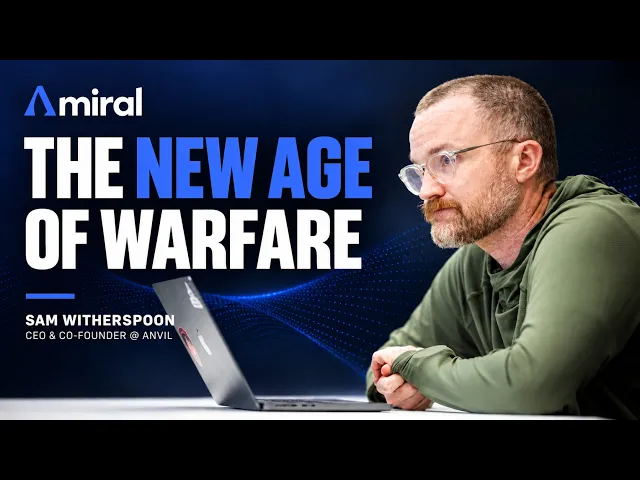
The New Age of Warfare with Sam Witherspoon, CEO & Co-Founder @ Anvil - a Canadian Defense company
Oct 5, 2026
Sam Witherspoon is the CEO and co-founder of Anvil, a Canadian company building the information layer behind military intelligence, pulling data out of siloed networks and repositories, normalizing it into a single open standard, and serving it up through mission applications that turn work that used to take hours or days into seconds or minutes. Roughly a decade in, Anvil sells across NATO, has just crossed 100 people, and has never taken venture capital.
We get into why Sam deliberately refuses commercial business, how a 30-minute training burden became his sharpest differentiator against the giants in the category, and the moral conversation Canada isn't having about lethal autonomous weapons systems. Sam is candid about the risks of the current defense funding boom, what he tells founders who show up looking for a government contract, and why he can't honestly promise a VC that a dollar in becomes a dollar thirteen out.
In this episode:
What Anvil actually does, and why everything lives in silos
"Victory through information advantage" — the mission, and selling across NATO
How Anvil differs from Palantir: 30 minutes of training, open APIs, no ambition to be everything to everyone
Why target development and weapons interfacing shouldn't exist in the private sector
Sensor fusion in practice: distinguishing a T-90 from a farmer's tractor
AI, Jevons paradox, and the danger of abstracting the human out of a targeting decision
Canada's bright red line on lethal autonomous weapons — and the debate we're avoiding
The origin story: banker's boxes, Steelcase as first paying customer, then RCMP and USSOCOM
Cracking Canadian procurement: an active clearance, a reference customer, and an engineer-lawyer
Warnings for defense tech founders: entitlement, "move fast and break things," and who's swimming naked when the tide goes out
Air-gapped networks, hot-swappable models, and gold-standard human-annotated evals
The magic wand: what is Canada's actual role in the world?
Why defense doesn't fit the traditional venture model — 32 potential customers on Earth
Hiring, growing in "gulps," and why Sam is optimistic about this moment in Canadian history
Transcript
[00:00:00] From my perspective, the threats have never been more clear. Mark Carney, I think, said it, "If you're not at the table, you're on the menu." Argue the middle powers must act together because if we're not at the table, we're on the menu. PTSD, there's a component of, you know, moral harm, and it becomes a tool of first resort, not a tool of last resort.
It, it is a complicated moral conversation that, as a society, we need to have as Canadians and, and, and frankly, we're far behind on.
Nectar: Sam, pleasure to have you on the podcast. We're really excited to be partnering in our new studio, so first guest in our new studio. Um, I really wanna dive into, like we s- we were talking about before recording, like so many topics. Uh, but I really wanna start with Anvil, and, uh, maybe at the simplest level, can you explain what [00:01:00] Anvil is, what Anvil does?
Sam: Yeah. Um, so the, the problem we solve is when, uh, when we're talking about information in any environment, corporate, um, but particularly military, um, everything lives in, you know, a, a huge number of silos spread across a bunch of different networks or a bunch of different repositories. Um, what we do, we bring them all together into, into one repository, standardize or normalize the data into a single open standard, and then serve it up through a bunch of different, we call them mission applications, but ways you can interact, exploit, uh, analyze, share the data.
Sam: Um, from a intelligence perspective, uh, which is the, the main area of focus we have, um, what we end up doing is providing tools that either expedite or automate those workflows that historically were entirely manual. So a user shows up, and five years ago would've done something, you know, completely manual on a map.
Sam: Uh, today it is, you know, ready, served up, available, approachable for them. So, you know, the [00:02:00] value extracted for the customer, dramatically lower training burden. You don't have to spend as long building an intelligence analyst. Um, you know, dramatically better compliance. You don't have to spend as long monitoring and maintaining your intelligence analyst.
Sam: And, you know, out the tail end, you get a dramatically faster, better product, so near real-time exploitation and dissemination versus, uh, you know, historically there was, you know, hours to, to days between identification to, uh, to effect. Now it's seconds to minutes. How much of the data is internal workflows versus capturing outside data/intelligence?
Sam: Um, it's a bit of both. Uh, you know, the, the, the push for sure has been, uh, open source intelligence is a, is a major sort of contributor now to a variety of intelligence workflows. Um, but nonetheless, you know, national technical means, the, the, the things that we do as a, as a country, um, to both create but also, um, you know, [00:03:00] exploit, uh, our, our adversaries' weaknesses or to identify them, um, necessarily have a classified component.
Sam: So we, we, we typically are seeing, you know, it's a fusion of the two as opposed to exclusively open source or exclusively sort of classified materials. Yeah. Maybe to, to ask the question a different way, like how do you describe Anvil's mission then? Yeah. I, I think, uh, you know, we, we felt for a long time, you know, over, over a decade now that, um- The, the opportunity really exists to, um, you know, you see a lot the, the sort of like decision superiority style, um, marketing or positioning.
Sam: And I think for us, the, the, the real value is, um, you know, we're there to help DND CAF fight and win. Um, and to do that, you have to know yourself, you have to know your adversary, and you have to know, you know, the operating environment. And so for us, it's, you know, victory through information advantage is, is sort of the, the tagline or the purpose.
Sam: But [00:04:00] fundamentally, to fight and win, um, you have to understand the, the totality, both your internal, uh, you know, operations, but also, you know, the influence you can have externally. And do you, do you think your company should only be selling to, let's say, Canada? Do you see like interest externally as well, or internationally, I should say?
Sam: Yeah. So we, we sell within NATO, um, so not just, uh, not just within Canada. Um, I think, you know, there are, there are some, you know, thousand-pound gorillas in the space, um, that especially in the current political environment make it difficult to sell in, in some of the largest markets within NATO. Um, but that doesn't mean that it is the right solution for everyone, and so, you know, we've, we've been quite successful at, you know, moving beyond Canada.
Sam: Um, but, uh, you know, obviously with, with some caveats to, to where we're able to operate. Yeah. We can, we can talk about Palantir a little bit. Yeah. But, but since we're on it, like so how is it different than what Palantir does? Uh, outside of it's not American. Yeah. Um, so a couple, a couple key differences that, that I would, [00:05:00] I would key in on.
Sam: The first is, uh, our training burden is about 30 minutes. Um, what, what I would, what I would characterize all of this as is, you know, these high-end, very complicated, very exquisite tools, um, are extremely challenging, especially with, you know, smaller or, um, you know- Less, less complicated workflows. So for us, uh, our main focus has been how do we make this extremely easy to use, extremely low training burden, um, so that, you know, your, your training burden is not a quarter of the time you have the person working in that position.
Sam: Um, the training burden is, like, 30 minutes to a day. Um, and so our, our fixation has been, you know, catering to the, the sort of 90% of, of the workflows and allowing, you know, power tools to be left for power users. So for us, you know, extreme fixation on interoperability. So how do we make sure that we play nicely with every tool, um, that, [00:06:00] that, that could be brought to bear?
Sam: Um, you know, making data move seamlessly in between the different services. Uh, and then the, the other component is making sure that, you know, where our ability to deliver on the mission effect ends doesn't necessarily get held up by our platform. So, you know, open APIs, we ship with complete documentation that allows them to, you know, move data between different services.
Sam: Um, and, you know, where, where we can't meet a capability requirement, it's often a very, you know, complicated, exquisite capability requirement. We make sure that it is a, a seamless transition into the software or the solution that, that does do that. And so distinct from Palantir, we don't wanna be everything to everyone.
Sam: Um, I don't wanna help, you know, Wendy's sell more burgers at the drive-through. Um, I don't, you know, aspire to any of those things. What we really wanna make sure is, you know, end to end, the mission gets completed and, and, uh, we don't wanna be the barrier or the rate-determining step for that. Yeah. I wanna get back to, like, maybe the, this moment [00:07:00] in time and where, like, warfare in general is going, but it's, like, it's a broad topic.
Nectar: Maybe specific to Anvil, is there, are there applications beyond the, the, the commercial government side? Like, how do you see it on the commercial-- like, on the cons- sorry, on the commercial side? Yeah. So, uh, we, we do no commercial business, and we don't aspire to do commercial business. Like, that's different than Palant- Palantir tries to sell to the big enterprises- Yeah
Nectar: right? Like- Yeah. Uh, so they have, they have products aimed squarely at the commercial marketplace. Um, we do not, and, uh, I think, you know, for a couple different reasons. One, um, for me, it's not a purposeful, uh, endeavor. I, I People can fill their boots. They can do what they want. For me, it's not something I'm particularly interested in.
Sam: Um, where I'm happiest is, is, is getting to work with, you know, national security, defense. Um, that is, that is my happy place and, and you know, one of the benefits of being bootstrapped is I, I get to make some of those decisions and make those rules. Um, the, the other side of it is [00:08:00] what we build is, is very unique in the sense that we are talking about, you know, target development.
Sam: Uh, we are talking about, you know, interfacing with weapons systems. Those are the problems that, you know, we are solving. Uh, those problems should not exist in the private sector, and if they do, we have a bigger problem than, uh- Yeah ... than, you know, my ability to scale my business larger. Um, and so I think, you know, for us, it's, it's that narrow focus that, like, we are gonna be really excellent at one thing, um, has been a sort of a, a critical enabler of how we got here.
Sam: Yeah. So like in a simplistic way, it's basically building like the context layer for all military intelligence, right? Yep. From offensive, defensive, to, uh, preemptive, right, understanding if enemies are preparing attacks, right? Yep. Well, how... Can you give us maybe a few, and I know, like, this is like we're talking about, like, sensitive conversations before.
Nectar: It's like we can't reveal everything, but like maybe use cases of how, uh, your customers have used the products- Yeah ... u- as you have used [00:09:00] your products. Yeah, so, so the, the sort of like, uh, characteristic example would be, um, you know, we're, we're, you know, engaged in a major combat operation, which by the way, Canada's not engaged in at the moment.
Sam: Um, but you know, we're engaged in a major combat operation. Uh, a whole bunch of different sensors are, are feeding information back. You have full motion video. You have, you know, airborne sensors, GMTI. You have space-based sensors, OPIR, that kind of thing. Um, and all of these things are coming in to an intelligence analyst, and they're being asked to identify, you know, potential enemy activity, uh, and then assess that against, you know, the, the sort of expected enemy behaviors and say, "What do we think the enemy is, is, is currently doing or engaged in?"
Sam: Um, and, and you know- Provide the information and insight of that assessment to senior leadership, uh, so that they can make a decision on how to act. So sense, make sense, decide, act. Um- Kind of like the [00:10:00] OODA loop? OODA loop. The loop. Yeah. Yeah, exactly. Yeah. Observe, orient, decide, act. It's- it's all, uh, you know, different- different versions of the same- Yeah
Sam: uh, different versions of the same sequence. Um, but fundamentally when- when we're talking about that, uh, how all of that arrives at the analyst desk, how they get to fuse all of that information in as close to real time as possible, uh, will dictate the outcome of- of whatever decision is taken and whatever action, um, you know, i- is- is the direct result of that.
Sam: What we've worked on very hard is to make sure that we can solve that, uh, as close to end to end as possible for the vast majority of the users. So you asked for an example You know, a- an, an intelligence officer is receiving information from a variety of sensors, how they take that information, how they correlate it with one another, make an assessment that this is an enemy tank versus a, you know, a, a truck from a civilian or a, you know, a, a plow plowing their field or a tractor.
Sam: Um, how you make [00:11:00] those decisions, uh, has, you know, real-life consequence. And so, you know, what information is available? What have we done to, you know, create confirmatory intelligence or, like, secondary and tertiary sourcing so that we can say, you know, we are very confident that this is a, a T-90 moving through the battle space as opposed to, you know, Farmer Bob plowing his field.
Sam: Um, these are critical, critical questions that, uh, you know, we've, we've worked very hard to make sure, you know, the analyst has all the tools in their toolbox to be able to answer correctly. Um, and then from there, the decision that can get made and the action that can be taken, uh, are, are defensible and reliable, and I think that has been, you know, the use case we have, we have, you know, hammered on for years at this point, is how do we get to that sort of action as fast as possible, but document it, maintain sort of chain of custody, understanding of how we got there, um, so that it is defensible, it is, you know, it can be revisited, and, and we understand exactly what we knew and when we knew it.
Nectar: Sure. It's [00:12:00] funny to think of the military as like a, as a traditional industry, but like I imagine by and large it still is, right? So like you're-- what Anvil's doing is almost like bringing technology/AI to, to its customers, right- Yep ... to, to, to the government. How do you-- have you seen your company ride that wave, right?
Nectar: Because it's like today it's like almost, uh, I imagine your customers are asking, "Hey, what about this AI thing?" Yeah. And it's like I imagine your products are now empowered to a larger extent. So curious how you've been using and experimenting with, uh, with these new tools. Yeah. So, um, there's a lot of, uh, risk that I think is being, um, underappreciated at the moment, uh, in terms of AI adoption.
Sam: Um, you know, when, uh, when we talk about, uh, you know, different, different companies and approaches, um, a- and f- and frankly, different sort of morals and ethics and, and sort of red lines that, that shall not be crossed, I think, um, we've for a long time viewed a lot [00:13:00] of the work that, that we do as being analogous to a, to a weapons system, even if it is not directly a, a, a weapons system.
Sam: And what I mean by that is, you know, the, the more automated, the, the more, um, abstracted the workflow and, and the underlying fusion of that information becomes from the user, the more likely we are to see users just take at face value the end recommendation or the end, the end sort of suggested output from the system.
Sam: So, you know, a, a good example, if you've used Cloud Code or, or the ChatGPT equivalent, um- The temptation exists almost immediately to bypass all of the permissions controls and approval workflows because you can go much faster if you're just like, you know, blanket approval, um, give me my next big output and let me see it.
Sam: And I think that, uh, the challenge that's created is this is not software that we are producing [00:14:00] as an out- end output. We are producing a targeting decision, um, that, you know, fundamentally has the, has the potential to, you know, destroy, disrupt, or disable the enemy. Um, the, the cost of that conversation being completely abstracted from the user, um, you know, uh, there's a, there's a principle in economics, and I'm, I'm gonna butcher the guy's name.
Sam: You can look it up and, uh ... But, uh, you know, the easier it is to do something, paradoxically the more we end up doing it is, is the- Jevons paradox ... Jevons paradox. And so thank you, yeah. And so, um, it is, it is going to become easier and easier to take lives, um, when we are talking about introducing more and more autonomy, and, you know, there are, there are trade-offs to that conversation, right?
Sam: PTSD, there's a component of, you know, moral harm when we have to make those decisions that, you know, we are very alert to and, and, and sensitive to. The, the [00:15:00] challenge becomes if you take that sort of cost and consequence away, we will do it more and more, and it becomes a, a tool of first resort, not a tool of last resort.
Sam: And I think that, um, you know, it is a, it is a complicated moral, uh, conversation that as a society we need to have as Canadians, and, and, and frankly, we're far behind on. Yeah. Yeah, it's tr- yeah, it's maybe a good, uh, good way to, to, like, talk about, like, you get a front seat of what's happening in, in modern warfare, right?
Nectar: Yeah. Like not talk about video games, but really, like... And I feel like the catalyst has been, you know, the, the war in, in Eastern Europe, right? Like that we're seeing, like for the first time ever, autonomous, uh, drones or vehicles- Yeah ... acting without human intervention. Yeah. How has, how has that changed in your view in the recent years?
Nectar: Like how, like modern w- like it still feels like we're in the first innings of like, "Hey, we just invented the tank," right? Yeah. It's like looking- Yeah ... back to World War I, right? Yeah, so, um, there is a, there is a very clear prohibition in [00:16:00] Canada right now on the utilization or fielding of lethal autonomous weapons systems.
Sam: It's forbidden. It is a bright red line we have said we will not cross, and I think that the- But if we don't, like, if our enemies, you know- It's going to be used against us- Yeah ... is, is the next comment, right? Yeah. It's going to be used against us, and I think that as a society, it is, it is imperative that, uh, we as Canadians start to engage with this conversation and understand, you know, the, the, the, the more fulsome sort of moral components that, that, that come with lethal autonomous weapons systems.
Sam: Do we want them to be used against us with, you know, no deterrent effect on our side? Do we have a, you know, a different line? And I think this conversation is, is one that with the recent attention that defense is getting, um, i- is an opportunity for us as a society to actually confront some of these questions, answer them as a, as a whole of society, as opposed to deferring this to, you know- Uh, uh, a policy conversation sort of behind [00:17:00] closed doors or quasi behind closed doors, drag it into the public forum, have that discourse and say, "Nope, this is a bright red line we will never cross, and we will occupy that moral high ground," potentially to the detriment of thousands of Canadian lives.
Sam: Um, or, "We will, but as a last resort," or, you know, "Here is the sequencing we expect to, to sort of morally justifiably, um, begin utilizing these weapons in the future." Yeah. It's analogous to, you know, nuclear non-proliferation. We've made similar decisions in the past. Chemical warfare. Like, there, there, there are l- landmines.
Sam: There are lots of instances where we have said the moral harm outweighs the benefit. We have not had that conversation to the same degree, I feel, in, in, in Canadian society. Yeah. 'Cause, yeah, it feels the, the old way of conducting, let's say, uh, wars is re- really changing, right? Mm-hmm. So, uh, if you look what's happening, it's like the, you know, the $50 million jet, you know, and, like, uh, I forget the exact term, but [00:18:00] it's, like, highly, uh, attributable or, like, high attrition rate vehicles- Yeah
Nectar: like a g- a d- Yeah ... a drone costs 2,000. 2,000. Yeah. Uh- Yeah ... and you can just send a swarm, a swarm of them, right? Yeah. So it's like that's, it's something that completely different in terms of- Yeah ... how we're operating. So I find what Anvil's mission is interesting is that it's really providing this, this, this, this layer of intelligence, right, for, for, for, for Canadian government- Yeah
Nectar: particularly government to be prepared, right? Yeah. So it feels like you're, what you've been building is kind of like, you know, you said, you said 13 years? Like, uh- Yeah ... 11, 13, depending on the pivot- Yeah ... uh, you, you've been doing it. This is like y- your company's built for this current moment. Mm-hmm. Right?
Nectar: Um, is that, when you started the company, is that what you envisioned? Like this moment today where it's like- No ... it's, like, literally, oh, you watch your headlines, you're like, "Oh, yeah, Anvil." Yeah. No, not at all. Um, you know, I think when I started the company, um- My intention was to solve a, a very, like, acute problem that I had experienced while working in the, in the public service.
Sam: Um, and, uh, [00:19:00] the, the problem was effectively, like, we were being presented with millions and millions of pages of, of paper documents that formed the basis of a, you know, a record of, of decisions made, um, the, the evidentiary record in that circumstance. And, and the challenge that we had was they were functionally useless.
Sam: Millions of pages in banker's boxes, uh, that were unsearchable, inaccessible, and, you know, I couldn't, couldn't even put into Excel and, and sort of interrogate in, you know, a very basic manner. And so the original problem I set out to solve was like, how do I just get these in an electronic form so I can do something useful, um, and, and be more diligent in, in, in the work I was trying to do?
Sam: And, uh, ironically never managed to solve that problem for the, for the place that, uh, that I was working. But, um, subsequent to that, uh, you know, there were, there were other [00:20:00] applications of, of the technology that, um, you know, military and, uh, and, you know, national policing, uh, public safety that, uh, we ended up being able to, to land much more successfully within.
Nectar: Sure. Uh, yeah, I grew up an '80s kid, and one of my favorite movies growing up was, you know, Jean-Claude Van Damme, Hard to Kill. Yeah. Like, it's the classic movie, which I believe is- Yeah ... Anvyl's model, right? Yeah. It's
Nectar: like I can't, I can't think of a harder kind of challenge which you had to undergo through, like bootstrap, selling into a category that is, like, just notoriously difficult with procurement, right? So can you walk us through maybe s- those early days of, like, bootstrapping, getting c- getting, getting contracts?
Sam: Yeah. Um, so our first customer that paid us money was actually Steelcase, the US, uh, office furniture company. Um, we'd built some, like, knowledge management software, uh, that transcribed audio. Uh, and they wanted to potentially embed it in [00:21:00] meeting rooms and turn static furniture into a SaaS-based solution where they could charge recurring revenue or generate recurring revenue on a conference room table, which, like, if you're an office furniture manufacturer, I think sounds pretty compelling from a business perspective.
Sam: Um- Ultimately, that went nowhere. We, uh, we got paid for, for two pilots. Um, but it really exposed us to, you know, there's a pathway here where, um, we could generate services business revenue and reinvest it in product and start to build out the thing we actually wanted to build. Um, and so, uh, that was the sort of genesis of, hey, if we, if we, you know, embed deeply with the customer, understand their problems, oftentimes better than they understand them, um, you know, there's a, there's a real potential here to, to deliver something that we want to deliver.
Sam: Um, from there, we did some work with RCMP, uh, ended up winning a large contract with [00:22:00] USSOCOM, which was, uh, one of the catalysts for us being able to enter the Canadian defense market, paradoxically. Cool. Um, and from there, uh, sort of the rest is history. But, like, services business, first and foremost, was, was how we managed to, to finance the, the bulk of our work.
Nectar: Yeah. I know, I know you've spoken about procurement and the challenges of procurement. Maybe not to, like, uh, you know, bring up some PTSD there. Um, but it's notoriously difficult, right, to get, uh- Yeah ... the Canadian government as a customer, right? So, like, uh, maybe at the high levels, how'd you crack the code?
Sam: Um, so I had a couple, a couple sort of, uh- unique features. The first was I still had an active security clearance. Uh, that made it easier to go in as a subcontractor very quickly. Um, so that was one. Uh, my clearance enabled me to sort of like fast track myself and a few other folks, uh, into, uh, being actively, uh, engaged with the customer.
Sam: Um, the [00:23:00] second was we had a fantastic reference customer in USSOCOM. Um, so, uh, you know, Canada likes to hear that you have another external customer before them. Uh, so that was another sort of, um, feather in our cap that we'd, we'd done this before, and we'd done it for, uh, you know, a very high-performing organization.
Sam: Um, and then, you know, the, the, the last one was I, I think my background was fairly unique and compelling in, in hindsight. I, I wouldn't have described myself that way before, but it made it very easy to go in and actually have value to add on day one as opposed to, um, you know, being a generic sort of consultant and- Yeah.
Nectar: And what was that background? Sorry. Yeah, so I, I, I have a, an engineering degree and a law degree, and, um, have worked in national security previously, and so that sort of, uh, triumvirate was, uh, it, it was a very easy, [00:24:00] uh, pitch to be like, "I am uniquely positioned to understand the regulatory, the, the compliance obligations, but also to be able to actually deliver a technical solution that meets those obligations, and you don't have to hire, you know, three or four different people to answer all of these questions.
Sam: You've got, you know, one resource that can- Cool ... that can do it all." And, you know, back when we started, it was, it was the lean times in defense, right? It was- Yeah ... we had to be efficient. We had to do things differently than, you know, throwing giant piles of money, uh, at, at potential solutions. It, it had to be one person wearing three hats to, to get your foot in the door.
Nectar: Right. What's changed, right? Like we see this, like this deluge of capital, you know, coming into the, you know- Yeah ... Canadian defense and, you know, there's a lot of funds being formed. Um, is it just this realization of like, you know, we're in a multipolar world, Canada has to be able to defend itself more, uh, and that's causing us to want to increase, you know, s- defense spending as a part, like percentage of our GDP, and that's been the [00:25:00] unlock?
Nectar: Like when... How do you see it from your side, like? Yeah, I think, uh, from my perspective, the threats have never been more clear. Um, we, we are living in a world where, you know, uh, to, you know, Mark Carney, I think, said it better than, than pretty much anyone else, like if you're not at the table, you're on the menu.
Sam: Um, and I think that, uh- You know, the Prime Minister has made his, his desire clear. We are, you know, re-industrializing, um, the, the Canadian Sovereign Defense Industrial Base. Um, and so I think what's changed is fundamentally the signal government is sending is, is a strong one. We are going to, you know, buy Canadian first.
Sam: Um, we are going to prioritize rebuilding the Canadian defense industry, and these are words, you know, that have not been spoken in a long, long time. Um, a- and I think that, uh, you know, it, it's wonderful that we are, we are taking it seriously and, and understanding that the, the threats in the world are, you know, [00:26:00] no...
Sam: There, there's never been a, a, a more dangerous time, um, in, in my lifetime anyway, and, you know, I lived through, through 9/11. Um, this is, this is, you know, the probably the scariest time, um, for, for myself, for my children. Like, it's a, it's a, it's a wild time to be alive. I think, um, it's, you know, it, it's a real opportunity.
Sam: I think the challenges ahead are still pretty significant. Um, the, the mechanism of, mechanisms of government, uh, are still figuring out what, what the new pace, what the new velocity will look like. And, um, you know, it takes a long time to, to turn a ship of that size, and, and I think, you know, I'm, I'm optimistic, but, uh, still time will tell.
Sam: Yeah. Yeah, there's still a lot of, like, change that needs to happen, right, for us to be a fast-moving speedboat, right? Yeah. Um, so the, do you see an opportunity for [00:27:00] startups? Like, there's a lot of talk about defense startups. You're obviously, I find, the poster child- Yeah ... in Canada for, for defense tech startups that have made it.
Nectar: Yeah. Is there misconceptions, things to watch out for if, you know, found- founders in the space are watching? I mean, uh, so, so there's, there's a, there's a couple, there's a couple concerns that I have about the, the, the current, uh, sort of, um, frothy market in, in defense. I think my first concern is there's a lot of people entering the market thinking they have a capability that's needed, but they've never talked- To their sort of prospective customer.
Sam: They don't really understand what the requirements are, um, and they're sort of entering because they heard there's money as opposed to entering because, you know, they, they have lived experience that there is a, you know, problem worth solving. Um, and there, there's a, there's almost an entitlement to like, "I'm entitled to a, [00:28:00] to a government contract," as opposed to like, "I must earn the right to, to, you know, work and serve the government of Canada."
Sam: I think that, that has me concerned just because it, it's, it's creating strange expectations, but it's also a drag on, on the system as a whole when you are getting pitched hundreds or thousands of times in a year on solutions that are just so detached from what the actual requirement that the government or the, th- that the DND CAF actually has.
Sam: Um, and, and I don't speak for the entirety or any of the DND CAF, but I, I think the, that is a, that is a persistent challenge that I see. Um, the other concern I have is, is the, the sort of traditional startup mentality of like, "I'm going to move fast. I'm gonna, you know, rapidly prototype and, and it- and iterate."
Sam: Um, it, it can probably work in, in certain areas. Attritable drones is a great example where I think that that opportunity where it's largely been commoditized at this point is, is, is probably a, a good example of a, of a place where, you know, building a [00:29:00] drone prototype, fielding it, testing it, and, and, you know, gathering feedback and iterating in that cycle.
Sam: Um, when we're talking about Decision-making that has, you know, the real potential to either cost Canadian lives or, um, you know, destroy, disrupt, or, or damage our adversaries. Um, move fast and break things is, is a very risky and dangerous mentality, and one that, um, I d- I don't think anyone who is truly serious, uh, would approach in that manner.
Sam: Um, because, you know, we're talking about the moral harm as well of the soldiers that you're equipping, and I think that that is a, uh, a real concern I have. Showing up and saying, "I've got this half-baked idea. Let's launch it and just, you know, field it and see how it goes," very dangerous. Um- Yeah, but y- I find you're also y- like, you know, you, you strike me as an intense individual, right?
Nectar: Yeah. Like that, that, uh, you know, didn't, you know, probably got told no a lot of times, right? Yeah, yeah. So not that you broke things, but you for sure f- move fast, had [00:30:00] intensity. Yeah. So, like, where do you find those character traits for yourself maybe other, you know, others can emulate from, from what you've done?
Sam: Yeah, I think, um, my, my grandfather gave me a plaque. I, I've, I've talked about it before, but it's a saying by Calvin Coolidge about persistence. And, um, I think, like, that is the, the sort of motto we have lived by is, like, we are going to persist, um, you know, in spite of the friction, in spite of the- Mm-hmm
Sam: you know, the challenges. Um, you know, it's, it's, it's, it's why, uh, you know, I, we're, we're in Montreal. I, I've, I've been watching the Bloc talk about how, uh, you know, they're not gonna hold a separatism refer- referendum until after Trump's out of office. Um, and very savvy political maneuver, right? Like, we all, we all understand exactly what they're saying.
Sam: But it speaks to the short-term thinking and the short-term memory that the Canadian population as an electorate has. Defense will not forever be a priority. We will return to the lean times, [00:31:00] and there will be two kinds of businesses, the kind of business that has operated during the, you know, the fat glut of, of defense spending, and there will be the businesses that have built enduring businesses that are going to, you know, survive and sustain the Canadian Armed Forces for the decades to come.
Sam: And I think I aspire to be in the latter category. We want to be here 30, 50 years from now, still delivering, still, still producing. Um, and, and I think that, uh, the risk with, with the current sort of influx is, you know, when you have that gold rush mentality, um, it's, it's very dangerous. Uh, you know, lots of people are gonna be hurt.
Sam: Um- Yeah. What's the expression? Um, you only know who's swimming naked when the tide goes out, right? That's right, yeah. So yeah, you wanna build a company where you have solid footing and, you know, stable cash flows. Uh, yeah, it's a, it's a challenge I see on my end, where it's like we get pitched a lot of defense tech startups, and what happens when the music stops- Yeah
Nectar: right? To your point. So I find that's a, that's a tough one, so I think it's a good advice. Um, [00:32:00] maybe I wanna go back to product. I'm bouncing all over, but, like, how are you using AI in your products today? And I wanna tie it into the, the current conversation around sovereignty, right? Yeah. It's like if you wanna ship all your data to, uh, you know, uh- Yeah
Nectar: an HQ in California. So I imagine you're having those kind of compromises internally, right? Yeah. Yeah, so most of our software runs on air-gapped networks that are owned and operated by the DND CAF. So we're, we're, we're a bit of anomaly, an anomaly in the sense that, uh, we are not a, like, cloud-native solution.
Sam: We don't sell via cloud, um, or, you know, we don't host. Uh, and so we're a bit distinct in that respect. So when it comes to, you know, what model they wanna use or, or how they wanna use it, um, that is a, a policy decision that, that, you know, the DND CAF needs to make and, and tell us. And so what it's, what it's really built for us is a bit of a, you know, resilience around, well, the, the [00:33:00] flavor of the month can come and go.
Sam: We've had to build systems that allow us to, you know, effectively hot swap what model they wanna deploy against it. Um, in terms of AI utilization, we've had, uh, we've had some, like, pretty entertaining experiences, uh, especially on exercises where, you know, the problem I highlighted earlier of people very quickly sort of turning off the, the, their brain and going, "You know, it made the recommendation, it must be a good recommendation."
Sam: Um, we've observed that. It, it's human nature, right? We're, we're going to take the, the shortcut, the path of least resistance where possible. Um, what we've seen, uh, in particular is people will very quickly start to utilize the models for their own entertainment when there are slow periods, and there are always slow periods.
Sam: Um, so we've seen, you know, silly poetry getting written. We've had short stories get written. Um, these are not on operational systems, but they are on, you know, long-term persistent exercise as an example. [00:34:00] Um, and they're fun and entertaining, but it's also... It, it, it highlights to me that there are, you know- remaining questions about how we actually wanna utilize some of these tools.
Sam: Um, and so our, our, our view is these are levers. The government can crank the lever up and say, "I want complete automated decision-making," or they can pull the lever way back and say, "We want no automated decision-making." It's our job to give them the lever, and they can pull or push the lever. Um, it's not our job to constrain that.
Sam: That is a policy conversation that they need to have and a decision they need to make. It's our job to enable the decision to be made easily, seamlessly, with as little intervention on our part or, or engagement as possible- Yeah ... so that they're making the informed decision. But we also bear an obligation to inform them of the risks.
Sam: Yeah. So that's, that's something we do very often. So on that last point, it kinda- it's, it's kinda my next question of like It's, I imagine it's such a c- it's a conversation that changes all the time, right? Yeah. It's like, "Oh, maybe you should use a Google model or an Anthropic-" Yeah ... [00:35:00] or these new Chinese open weight models Yeah
Nectar: right? Like, 'cause it's like, you, you have to use these, you know, these frontier models- Yeah ... to a certain extent today, right? Otherwise, going back, you'll be left behind. Yep. How have you approached that conversation with your customers? So, uh, we talk about what we perceive as the risks and what our own security posture is, uh, as it relates to these.
Sam: Uh, it is an ongoing and open conversation. I don't wanna leave anyone with the impression that like there is a- It's changing every other week anyways ... there is a decision- Yeah ... that has been rendered. Um, and so our philosophy is it's a, it's a constant evolutionary conversation. Um, one of the things we have worked really hard to make sure of and, and we continue to advocate for is whether we're talking about lethal autonomous weapons systems, or whether we're talking about just the utilization of LLMs, um, when we're having those conversations, step one is having good evaluation sets that are gold standard human annotated, so we can properly assess the impact of, you know, [00:36:00] if you wanna use a, you know, a Cohere model, or you wanna use an Anthropic model, or you wanna use a, you know, OpenAI model.
Sam: Having, having the ability to automatically assess the performance of the model and say, "These are the trade-offs, these are the benefits." Um, it has to be done at scale. It has to be done with, you know, human annotated, human assessed data. These are the things that enable us to be, you know, dynamic, efficient, fast at, at fielding any new capability.
Sam: Lethal autonomous weapons systems, same deal. You wanna field something, you need all of the sensors in appropriate context with, like, an actual targeting decision made at the end to be able to say, "This is a safe within our, within our definition," which is still to be defined, but if you want to go down that route, we need to have that conversation and say, "What is the framework we will test, evaluate, and field these capabilities under?"
Sam: It's all going to start with gold standard human annotated, human monitored and assessed data, um, in the [00:37:00] context that it's supposed to be operating in. And so we've been pushing and having that conversation for nearly a decade now. Yeah. You wanna field a model, you have to be able to assess how performant that model is.
Nectar: Yeah. Yeah. It's interesting. Yeah, like we like that insight. Um, I imagine maybe on the, on the government side, like, uh, we could maybe cut this question out, but what do you see as like, you know, the, the classic magic wand question, like if you had to change one thing to improve, let's say, be it procurement, et cetera, like how can our, our defense forces be more capable, uh, considering there, there's all this influx of, of investment into the space?
Sam: Um, I think, I think there's a- Magic wand. Great question. Um, I think what I would do is I would wave my magic wand on the Canadian public and rapidly mature the conversation that the public is capable of having around what do we expect the Canadian Armed Forces to be [00:38:00] doing on our behalf? Where do we want them to be, and what, you know, what is and is not the expected mission set that, that we want from our DND CAF?
Sam: Um, what I mean by that, uh, you know, there's, there's a whole bunch of debate around the F-35 right now. Should we abandon it? Should we take the ones we've bought, taken delivery of? Should we continue with the procurement? And the piece of that debate that I feel is missing is like, what is Canada's intended role in the world?
Sam: The F-35 is a phenomenal platform, and it has, you know, an unequivocal role as, as, you know, the best platform, um, available to, to Canada. But Do we need first strike? Do we need a stealth fighter? Like, these are questions that, you know, has Canada ever fought in a conflict where we, you know, shot first? These are questions that we need to, you know, we need to define our place in the world and, and that is a conversation that the Canadian public needs [00:39:00] to rapidly get sharp on, um, because it is, it is a conversation we're not having.
Sam: What is our place in the world? I think, you know, the prime minister has done a phenomenal job, middle power competition, like all, all, all of his, his conversation and speech at Davos was phenomenal at, at starting that conversation. What hasn't matured is, is the conversation around that, where Canadians are starting to talk about it at the dinner table.
Sam: Everyone loved that Mark Carney gave a phenomenal speech at Davos. That was dinner table conversation. What we didn't do next was continue that on to, well, are we going to be, you know, deeply serious about this and understand the sacrifices that we are going to have to make to get there? Or are we, you know, still going to live in our comfortable fortress North America without confronting that we live in fortress North America?
Sam: Yeah. Yeah, maybe bring it, to bring it back to technology for a second, I find it's like it's companies like yours that are gonna help us see through- Yeah ... no matter what, right? Because it's not with the old ways, right? We need the, the best and [00:40:00] brightest people working with, with technologies. Um, so yeah, I can't answer the que- it's a good question.
Nectar: It's like I'm not ill-equipped to, to- Yeah ... you know, provide feedback, but I feel like it is, it is a good point. And maybe on that, on that side then, like, what is your ambition for Anvil, right? Like, it feels like, yes, 10 years in, the like, you've heard it's in a scale, but like still feels like you're just getting started and built for this current moment.
Nectar: Ca- have you articulated a, like a broader vision for, for, for where you're going? Yeah, so I think, um, our intention is, uh, to, you know, remain sort of the, the trusted partner, the, the subject matter experts on, on what we do best, which is, you know, knowledge management, information management in support of, uh, you know, intelligence production.
Sam: Horizontally, we've, we've branched out into, you know, in support to ops, in support to plans. We've started bringing in, you know, more data types, um, and, and data sources that would [00:41:00] not conventionally be considered, you know, intelligence related. Um, and so Our aspiration is to be the absolute best at, at doing these things.
Sam: Um, and one of the benefits, I, I said it earlier, one of the benefits of being bootstrapped is, like, if it doesn't get me up in the morning and, and doesn't excite me, I kind of have the luxury of getting to say, "These are the problems I wanna solve." And, you know, at the expense of all the problems we, we don't have to solve, and I think that focus, you know, you, you asked what are, what are some of the differentiators?
Sam: I think that's frankly another one, is we don't have to solve every problem. We get to solve the problems that we know we're, you know, excellent and, and, and unique subject matter experts at solving. And I think it's been a, you know, a real advantage. We don't have to divert our focus to fixing this for Wendy's or fixing this for Steelcase.
Sam: We've been able to let all of that, you know, slough off and be really, you know, narrowly focused at solving the problems that we are truly passionate about solving. Yeah. [00:42:00] I don't wanna get... You mentioned something before that stuck with me about, you know, how it's, like, a very dangerous time, and it's... I don't wanna get into, like, the doomerism side, um, 'cause it's human behavior- Yeah
Nectar: to, like, talk about shit that could go wrong. What, what, what makes you optimistic for the future, stuff that you're excited about? Yeah, I mean- I, I, I, uh, I think we are at a very exciting point in, in Canadian history. Um, I think that regardless of what the next years hold, people are gonna write books about this time period.
Sam: Like, that is, you know, it, it's, uh, it's a truism to say we're living through history or, you know- Mm-hmm ... these are historical times. Yes, of course, but I think very, very unique period in Canadian history. Um, and, and a time of, you know, great transition and change, and I think, uh, historically, periods of transition and change have a- also been periods of, you know, huge potential, uh, you know, huge opportunity.
Sam: And so, um, I'm optimistic that, uh, you know, we are [00:43:00] on a, on a, on a path as a country that, um, is a, is a very strong one. It's gonna be hard. Like, I think we, we all know that intuitively, but I think watching the Canadian public sort of pull together and, uh, you know, cross political lines in a way that w- we probably haven't been capable of doing in, in, you know, previous times.
Sam: Um, e- even COVID was a, was an example where, you know, politics still seemed to unfortunately play a role. This has, this has been a, a pretty inspiring time to, to be a Canadian, and I'm, I'm excited about it. Uh, I think it's a, it's a, you know, huge potential in front of us. Yeah. Definitely feels like a, a wake-up call, right?
Nectar: Like, the ... I think it's been said, right, the, the best thing to happen to Canada is this, this latest, you know, US administration that just kind of kicked us in the butt a bit and- Yeah ... w- woke up the country, right? So for, for good and for bad. Um, I feel it's a good spot to wrap, but I want to maybe ask for the audience, like, anything you're looking for?
Nectar: You guys are hiring, like, like mad right now. It's- Maybe to, like- Yeah, yeah ... if people want to reach out with their CVs. [00:44:00] Absolutely. I mean, send me a message. Uh, I'm very easily findable on LinkedIn. If you are unable to find me on LinkedIn, you probably don't deserve a job at an intelligence company. Um, but yeah, I think, uh, you know, if you're a startup, um, there, there's a bunch that have, that have reached out to me and, and sort of asked for, asked for advice.
Sam: I am more than happy to give people some time and be like, "Here is what I would and wouldn't do." Be prepared for my first piece of advice to be like, "Don't enter the defense industry, and find a first customer elsewhere. Um, take your lumps and, and, you know, make sure you actually understand the problem you want to solve."
Sam: But, like, I'm happy to talk to you and tell you, you know, anything you want to know. Again, within the, the limits that are imposed on me- Yeah ... by, by law. But, um, happy to have those conversations with, uh, with anyone. Yeah. So don't be shy to reach out. Well, you mentioned some of your hiring plans, like some numbers are public, right?
Nectar: Like how many people are you looking to hire? Like, uh- Yeah, we're, I think we either just crossed 100 or we are about to cross 100. Um, it would be, uh... We, we grow be, I mean, again, because we're [00:45:00] bootstrapped, we grow in these sort of like gulps. Um, and so we're about to enter a bit of a consolidation phase, where the latest gulp was a big one.
Sam: I think we hired 25 or 30 people in sort of one go. Um, we're gonna consolidate for a month or two, sort of stabilize the team, you know, make sure everyone gets, gets properly integrated. It's also a reflection of how contracting works. Um, we are not, uh, you know, a SaaS business where every day there's people signing up and we're continually growing.
Sam: We grow in step functions. And so, you know, one of the benefits of being bootstrapped is we, we grow within our, within our, you know, within our means. Um, one of the, one of the drawbacks is, you know, you grow in a step function. You zoom out far enough and it still looks like a line, but but, but that's a, that's a stupid joke.
Sam: It, it's really like we grow in, we grow in gulps. And so we just took a big one. Um, I know there's still a bunch of roles open. Um, and so, you know, always, always keen to hear from people. But, uh, there, there's definitely a consolidation phase [00:46:00] on the horizon where we integrate the team and- Yeah. I imagine there's people chasing you, "Hey, take my money."
Nectar: Like, have you thought about your capital structure long term? And it's like, it's one of those like, you know, there's probably, you know, like imagine you evaluate depending on the opportunity. Yeah. And it can also change in the future. But like h- have you thought about what's best for, you know, medium term for, for IronFall?
Sam: Yeah. Um, I've learned long ago to never say never on anything. I think, um, we've enjoyed the, the freedom, uh, that being bootstrapped has offered us. It doesn't change that on the horizon we feel there are some, you know, massive sort of R&D investments that if we changed our capital structure, we might be able to sort of pull from, you know, the roadmap over here into the present day.
Sam: Um, but I, I think that my concern remains that the business itself in defense does not lend itself to traditional venture capital. I can't say, "Give me a [00:47:00] dollar," and I can reliably turn it into a $1.10 or a $1.13. I, I can't plot that course for, for a traditional venture capitalist because, you know- Even on the best day, there are 32 potential customers on Earth for our software.
Sam: That's NATO. Um, strike a couple of them off 'cause we've already won them. Strike a couple of them off 'cause we will never win them, and, like, there's probably 28 customers, 27 customers left for us. Um, and, you know, the total addressable market is finite. It's zero sum. If we don't win it, it's gone. Um, so if someone else takes it, there's nothing left.
Sam: Um, it's one of the few industries where, like, I can, you know, on the back of a napkin, sketch out exactly what our total addressable market would be. We can multiply it by .3 and say, "Do you still think this is a great investment?" Um, and I think that Each [00:48:00] of those nations has their own distinct procurement framework, own distinct national champions that they aspire to build.
Sam: Um, and so you can probably have it again before we even start the conversation. It's a really complicated, messy, ugly industry where the sales cycles are bizarre, forecasting is nearly impossible. You know, I couldn't reliably look someone in the, in the eyes and say, "Give me a dollar, and I'll make it- Yeah
Sam: a dollar 13." And, and, like, that has, in my mind, been the historical, like, venture model of like, we can turn your money into more money. I'm not convinced anyone can do- But there's like, yeah, there's other financing paths, right? Yeah. It's not just VCs. Yeah. Could be other ones, but yeah. So we, we use, we use, um, like, contract financing, uh, already.
Sam: Yeah. So we do that through our banks and, you know, banking covenants and that kind of thing. But I, I think, like, the, the other side is, you know, two, three years ago, um, we almost got de-banked, uh, 'cause we worked in defense. Yeah. How times have changed. Um- Like, oh, man ... but, but, [00:49:00] like, you know, that's the, that's the reality two, three years ago.
Sam: So, like, you know, two, three years ago we couldn't get funding from a variety of government sources. Yeah. Uh, and so it's been, uh, you know, a massive shift, which is, which is positive, but I think it's, uh, it's still early days to figure out if any of this translates into- Still got work to do, man. Yeah. Um, Sam, I could, I could probably bug you for another hour, and we'll, I'll try not keep you too much.
Nectar: Uh, maybe last question. You kinda dimensioned if people wanna reach out, but if you wanted, people wanna follow the Anvil journey- Yeah ... what's, what's the best way? Um, because of the industry we work in, we don't do a ton of social media. Best place, uh, is unequivocally LinkedIn. We, we do have a, a LinkedIn presence.
Sam: Um, it does not share the bulk of the work we do, um, out of necessity. Uh, but I think, you know, that, that, that is the, the most direct conduit. Um, you know, as, as you've experienced, you send me a LinkedIn message, you, you send me an email, I'm happy to chat. Like, I'm, I'm, I'm, uh, as, as open a book as I can be.
Sam: So, [00:50:00] um, you know, it's a, it's, it's a, it's a long truism in intelligence, like, there's no bad meeting. Um, I, I, I firmly believe that. I'll, I'll always chat with someone. Um, and so, you know, if you wanna know more, I, I'm happy to, happy to speak with anyone, so. Appreciate your time. Yeah. Thank you. Thank you. Okay, that's take one, so we- All right, we have to do it all over again.
Nectar: That's good guys? Yeah. Yeah. Cameras were rolling. Yeah.